
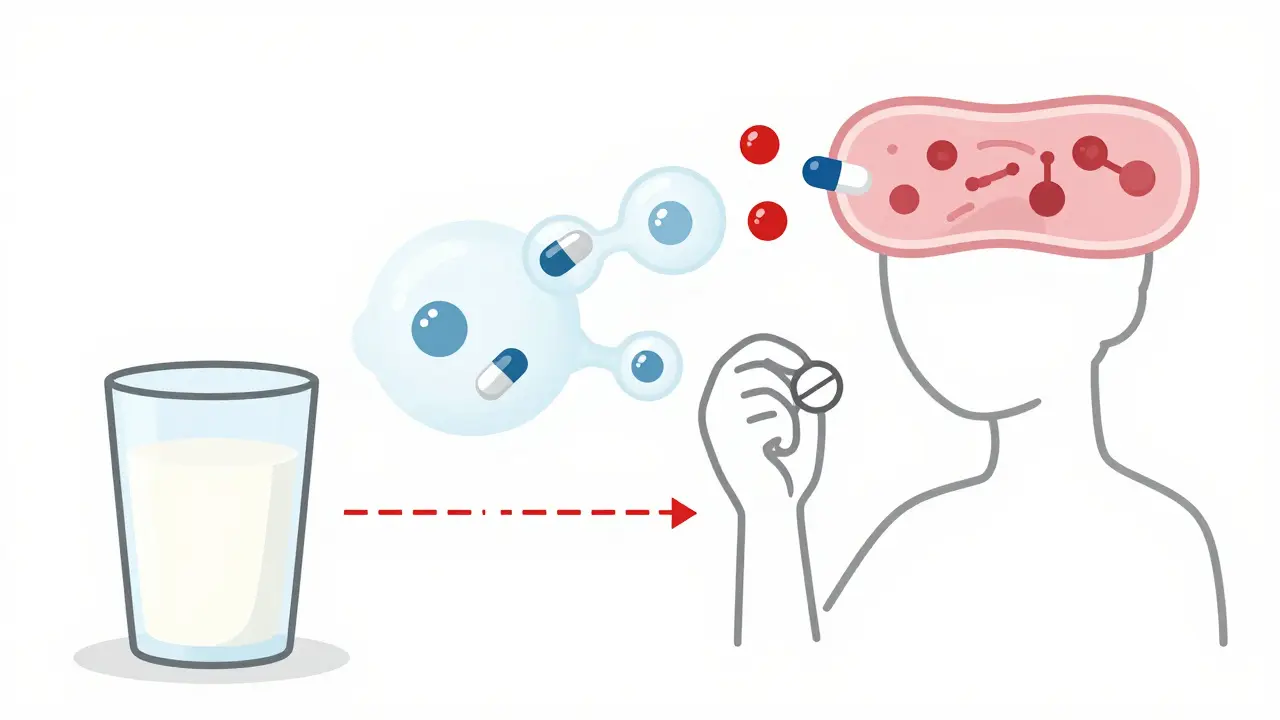
When you’re sick and prescribed an antibiotic, you want it to work. But what if the very thing you eat with it - like a glass of milk, a bowl of yogurt, or even a calcium-fortified orange juice - is quietly sabotaging your treatment? This isn’t a myth. It’s chemistry. And it’s happening to thousands of people every day.
Why Dairy Messes With Antibiotics
The problem isn’t dairy itself. It’s the calcium in it. When you swallow an antibiotic like tetracycline or ciprofloxacin at the same time as dairy, the calcium binds to the drug molecules in your stomach and intestines. This forms a solid, chalky compound that your body can’t absorb. Instead of entering your bloodstream to fight infection, the antibiotic just passes through you - useless. This isn’t new science. Researchers first noticed this in the 1960s with tetracycline. Since then, dozens of studies have confirmed it. One 2022 study found that yogurt cut ciprofloxacin absorption by 92%. Milk? Still bad - it dropped levels by 70%. Even low-fat dairy doesn’t help much. The calcium is still there, and it still binds.Which Antibiotics Are Affected?
Not all antibiotics are equally vulnerable. Some are barely touched by dairy. Others? They’re ruined by it. Tetracyclines - including tetracycline, doxycycline, and minocycline - are the most sensitive. These drugs are designed to latch onto metal ions, and calcium is just one of them. Studies show absorption can drop by 50% to 90% if taken with dairy. Doxycycline is a bit less affected than older tetracyclines, but it’s still risky. Don’t assume it’s safe. Fluoroquinolones like ciprofloxacin, levofloxacin, and moxifloxacin are next in line. These are common for UTIs, sinus infections, and bronchitis. One patient report from HealthUnlocked described a recurring UTI that only cleared up after switching from yogurt at night to waiting four hours after taking ciprofloxacin. That’s not luck - that’s science. Other offenders include bisphosphonates (used for osteoporosis) and some iron supplements. Even calcium-fortified plant milks - almond, soy, oat - can cause the same problem. They’re not dairy, but they’re loaded with added calcium. If it says “fortified with calcium,” treat it like milk.What About Penicillin or Amoxicillin?
Good news: most penicillins, cephalosporins, macrolides (like azithromycin), and sulfonamides don’t interact with dairy. You can eat your cheese sandwich with amoxicillin and be fine. But if you’re on doxycycline or ciprofloxacin? Don’t assume. Always check the label or ask your pharmacist.How Long Should You Wait?
Timing isn’t just a suggestion. It’s the difference between healing and lingering infection. For tetracyclines, take the pill at least 1 hour before or 2 hours after eating dairy. Some experts recommend 3 hours to be extra safe, especially if you’re treating something serious like Lyme disease or a deep infection. For fluoroquinolones like ciprofloxacin, the window is wider. Take it 2 hours before dairy, and wait 4 to 6 hours after before having yogurt, cheese, or milk. Why the longer wait? These drugs stay active longer in your gut, and calcium can still bind even hours later. A 2023 study in the Journal of Patient Experience tracked 200 people on affected antibiotics. Those who followed the 2-hour rule had a 98% success rate. Those who didn’t? Only 72% got better. The rest ended up with longer infections, more doctor visits, or worse - antibiotic resistance.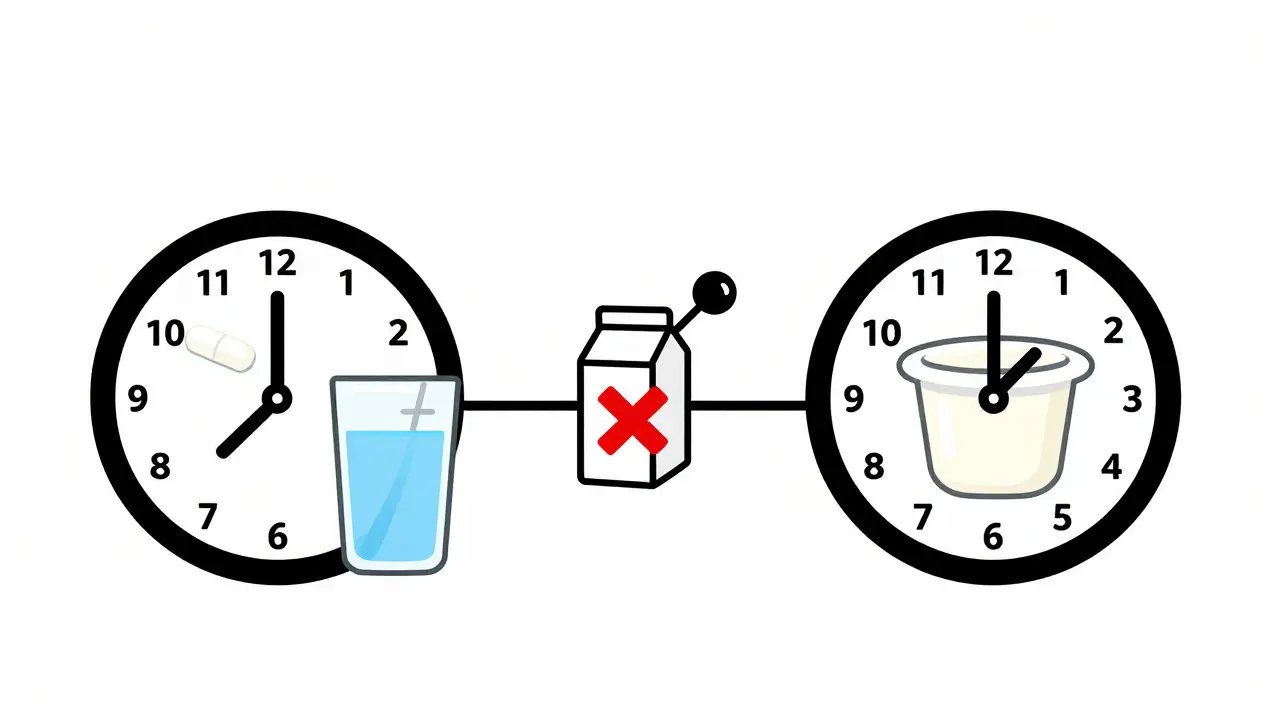
Real People, Real Mistakes
This isn’t theoretical. It’s happening in kitchens, dorm rooms, and nursing homes. A nurse on Reddit shared a case: a patient on doxycycline for Lyme disease kept getting worse. She was taking it with breakfast - milk, cereal, yogurt. Once she switched to taking the pill before breakfast and waited two hours, her fever broke in 48 hours. A 2022 survey by the American Society of Health-System Pharmacists found that 43% of patients were never told about dairy interactions when prescribed tetracyclines or fluoroquinolones. That’s not negligence - it’s a system failure. Prescribers assume patients know. Patients assume it’s fine. And it’s not just adults. Kids on antibiotics for ear infections often get their meds with milk or juice. If that juice is calcium-fortified? Same problem. No one tells them.What Can You Do?
Here’s how to make sure your antibiotic works:- Read the label. If it says “take on an empty stomach” or “avoid dairy,” that’s your cue.
- Take it first thing in the morning. Before coffee, before cereal, before milk. Wait 2 hours before eating anything with calcium.
- Plan your meals. If you take your antibiotic twice a day, schedule it for 8 a.m. and 8 p.m. Eat dairy at noon and 5 p.m. That keeps them separated.
- Check your drinks. Orange juice? Only if it’s not fortified. Soy milk? Same rule. Even some protein shakes have added calcium.
- Ask your pharmacist. They see this every day. They’ll tell you if your antibiotic is at risk - and how to avoid it.
What About Calcium Supplements?
Same rule. Calcium pills, chewables, or gummies? Don’t take them within 2 to 6 hours of your antibiotic. Many older adults take calcium for bone health and antibiotics for infections. They’re not aware these two are fighting each other in their gut. That’s why treatment fails.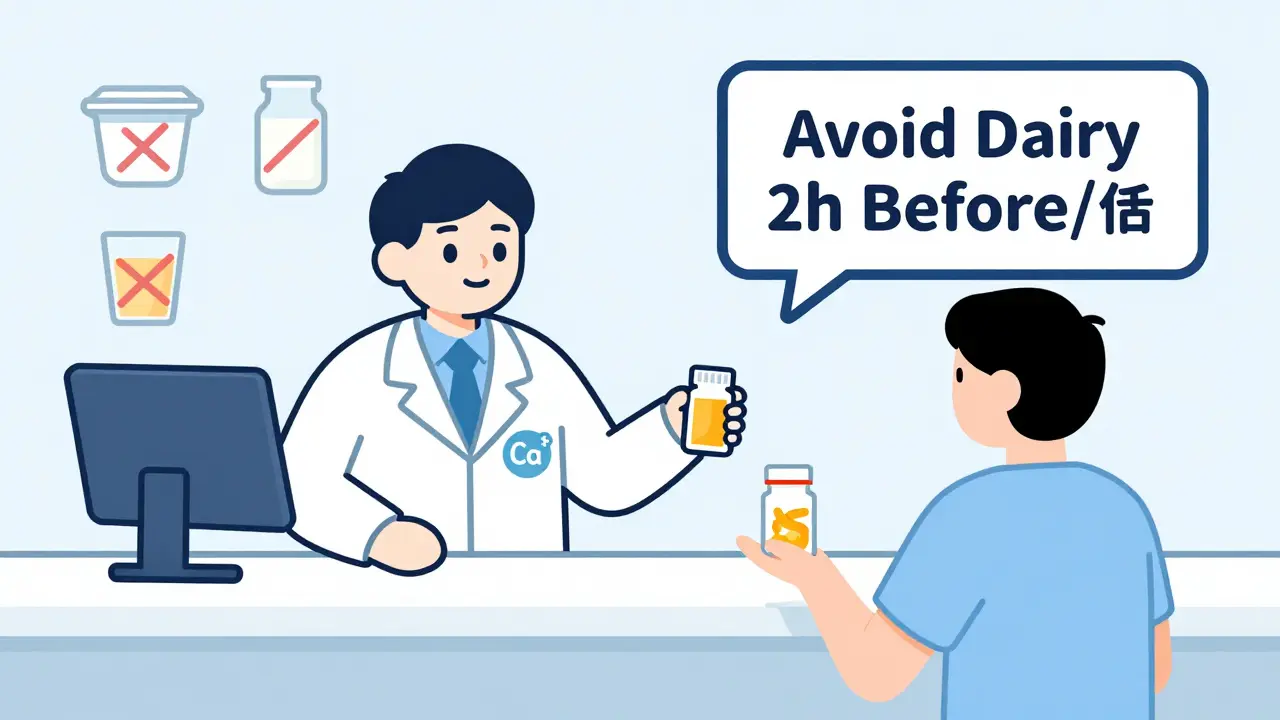
Why This Matters Beyond Your Own Health
When antibiotics don’t work because of poor timing, the infection doesn’t just stick around - it gets stronger. Bacteria survive, adapt, and multiply. That’s how antibiotic resistance starts. The World Health Organization says improper dosing - including timing errors with food - contributes to 5-10% of community-based antibiotic resistance. That’s not a small number. That’s millions of infections every year that become harder to treat because someone had yogurt with their pill.What’s Changing?
The FDA updated labeling rules in January 2023. Now, all tetracycline and fluoroquinolone packages must clearly state the dairy interaction and timing instructions. That’s a big step. Digital apps like Medisafe and MyMeds now alert users if they log an antibiotic and a dairy product together. Pharmacists are training staff to ask: “Do you drink milk or eat yogurt with your meds?” Newer versions of ciprofloxacin, like Cipro XR, are designed to be less affected by calcium. But they cost over $200 - ten times more than the generic. For most people, timing is still the cheapest, most effective solution.Bottom Line
You don’t have to give up dairy forever. You just have to time it right. One hour before. Two hours after. Four to six hours after fluoroquinolones. That’s it. If you’re on an antibiotic and you’re not getting better - and you’re eating dairy - this could be why. Talk to your pharmacist. Change your routine. Your body will thank you.Can I take my antibiotic with a glass of milk?
No. Milk contains calcium, which binds to tetracycline and fluoroquinolone antibiotics, preventing them from being absorbed. This can reduce their effectiveness by up to 90%. Always take these antibiotics at least 1-2 hours before or 4-6 hours after consuming milk or other dairy products.
Does yogurt affect antibiotics the same way as milk?
Yes - and sometimes worse. Yogurt can reduce ciprofloxacin absorption by 92%, compared to 70% for milk. The calcium content is similar, and the live cultures in yogurt don’t prevent the binding. Treat yogurt like milk when taking affected antibiotics.
Is almond milk or soy milk safe with antibiotics?
Only if it’s not fortified with calcium. Many plant-based milks are enriched with calcium to mimic dairy. Check the label. If it says “calcium carbonate” or “calcium phosphate” in the ingredients, avoid it with antibiotics. Stick to plain, unfortified versions.
What if I accidentally take my antibiotic with dairy?
Don’t panic. Don’t double the dose. Just skip the next dairy meal and resume your normal timing. One mistake won’t ruin your treatment - but doing it daily might. If your symptoms don’t improve, contact your doctor. You may need a different antibiotic or a longer course.
Do all antibiotics interact with dairy?
No. Penicillins (like amoxicillin), cephalosporins, azithromycin, and many others have no known interaction with dairy. But if your antibiotic is a tetracycline (doxycycline, etc.) or fluoroquinolone (ciprofloxacin, etc.), dairy can interfere. Always check the medication guide or ask your pharmacist.
Why does this interaction happen?
Calcium and other minerals in dairy bind chemically to certain antibiotics, forming insoluble complexes. These complexes can’t pass through the intestinal wall into your bloodstream. So the antibiotic passes through your system unused - like a key that won’t turn in a lock.
Can I take my antibiotic with water?
Yes. Water is the best choice. Avoid juice, coffee, tea, or milk. Some antibiotics also interact with caffeine or citrus. Always follow the instructions on your prescription. When in doubt, take it with plain water.
How long does it take for dairy to leave my system?
Calcium from dairy stays active in your digestive tract for several hours. That’s why you need to wait 4-6 hours after eating dairy before taking fluoroquinolones. Even if you feel like the food is digested, the calcium is still there - and still binding to your medicine.
Kelly McRainey Moore
January 19, 2026 AT 17:09Wow, I had no idea my morning yogurt was sabotaging my antibiotics. I’ve been taking doxycycline with breakfast for months and wondering why I never fully recovered. Time to switch to black coffee and wait two hours. Thanks for the wake-up call.
Roisin Kelly
January 21, 2026 AT 10:37This is all just Big Pharma’s way to sell you more pills. They don’t want you to know you can just drink milk and be fine. My grandma took penicillin with cheese for 40 years and lived to 98. Trust me, you’re being manipulated.
michelle Brownsea
January 21, 2026 AT 12:29Let me just say this: if you’re taking antibiotics and you’re still consuming calcium-rich foods without reading the label, you’re not just being careless-you’re actively endangering public health. The fact that 43% of patients aren’t warned? That’s not an oversight. It’s negligence wrapped in lazy prescribing. And now we’re paying the price in antibiotic resistance. Wake up. Read the damn pamphlet. Your body isn’t a suggestion box.
lokesh prasanth
January 21, 2026 AT 16:57calcium binds. simple. no mystic. just chem. stop eating dairy with cipro. done.
Sangeeta Isaac
January 23, 2026 AT 06:22So… I’ve been taking my azithromycin with almond milk because I thought it was ‘plant-based’ so it was safe… turns out my ‘healthy’ oat milk latte was actually sabotaging my doxycycline last time? 😳 I’m going to need a flowchart for this.
Ashok Sakra
January 24, 2026 AT 01:46They don't want you to know this! The government and Big Dairy are in cahoots! They pump calcium into everything so you get sick and need more meds! I saw a video on TikTok where a guy stopped drinking milk and his sinus infection vanished in 2 days! They’re hiding the truth!!
Andrew Rinaldi
January 25, 2026 AT 06:26I appreciate the clarity here. It’s easy to assume ‘natural’ means ‘harmless,’ but chemistry doesn’t care about our intentions. I’ve been on cipro twice now-both times I waited six hours after yogurt-and both times I recovered fully. Timing isn’t just advice; it’s the difference between healing and enduring. Respect the science, not just the convenience.
Gerard Jordan
January 25, 2026 AT 07:25Just a heads-up 🌱 if you’re using plant milks-always check the label. My soy milk had 30% DV of calcium. I thought I was being healthy… turns out I was just making my antibiotic useless. Now I keep a little notepad by my meds: ‘Dairy? No. Fortified? No. Water? Yes.’ 🙌
Yuri Hyuga
January 26, 2026 AT 17:56As someone who has counseled hundreds of patients on medication adherence, I can confirm: timing errors with dairy are among the most common-and preventable-causes of treatment failure. This isn't just about individual health; it's about preserving the efficacy of our last-line antibiotics. A simple 2-hour gap can save lives. Please, pharmacists: make this a standard question. Prescribers: print it on the bottle. Patients: listen. We can fix this.
Coral Bosley
January 27, 2026 AT 03:19I’ve been on doxycycline for Lyme and I swear I’ve been cursed. Fever comes back every time I eat cheese. I thought it was stress. Turns out it was my damn grilled cheese sandwich. I’m not crying-I’m just… really, really mad. Like, scream-into-a-pillow mad. Why didn’t anyone tell me this?!
MAHENDRA MEGHWAL
January 27, 2026 AT 19:15Thank you for this meticulously researched and clearly articulated exposition. The integration of clinical data with real-world patient experiences elevates the discourse beyond mere instruction to a profound public health imperative. One must exercise diligence not only in pharmacological compliance but also in the comprehension of biochemical interactions within the human gastrointestinal milieu.
Ben McKibbin
January 29, 2026 AT 05:53People treat antibiotics like candy. You don’t take ibuprofen with grapefruit and expect it to work-why treat antibiotics differently? The calcium binding isn’t some obscure footnote-it’s written in bold on the bottle. If you skip it, you’re not just wasting your own time, you’re fueling a global crisis. This isn’t a ‘maybe.’ It’s a ‘must.’
Alex Carletti Gouvea
January 29, 2026 AT 06:08So now we’re blaming milk for America’s antibiotic problems? What’s next? Are we going to ban breakfast because some people can’t read labels? This is why we’re weak. We need discipline, not hand-holding. Take your pills like a grown-up. No one’s stopping you from drinking milk later.
michelle Brownsea
January 29, 2026 AT 17:06And yet, here we are-still arguing about whether milk is the villain or if people are just too lazy to read the tiny print. Let’s not forget: the FDA updated labeling rules in 2023. If you’re still confused, it’s not the system’s fault. It’s yours. You didn’t look. You didn’t ask. You assumed. And now you’re surprised your infection didn’t clear? That’s not science failing. That’s human apathy.