
Drug Warning Checker
Enter your medical condition and the medication you're taking. This tool helps you understand if there are contraindications or warnings related to your specific situation.
Important: This is for informational purposes only. Always consult your doctor or pharmacist for medical advice.
Example from the article: Warfarin has a boxed warning for major bleeding. If you have kidney disease and take Warfarin, this is a relative contraindication requiring careful monitoring.
Every pill bottle, every prescription box, every OTC package has a label. But most people glance at it like a receipt-just enough to find the name and dose, then move on. That’s dangerous. The drug label isn’t just instructions. It’s your last line of defense against serious harm. The FDA requires manufacturers to include detailed contraindications and warnings because people die when these aren’t understood. You don’t need to be a doctor to read them. You just need to know where to look and what the words really mean.
What’s the Difference Between a Contraindication and a Warning?
They sound similar, but they’re not the same. A contraindication means: don’t take this drug at all. It’s a hard stop. For example, if you have a severe liver disease and your prescription says ‘contraindicated in severe hepatic impairment,’ that means the drug can cause liver failure in your case. No exceptions. No ‘maybe if I take less.’ The risk is too high.
A warning, on the other hand, says: ‘This drug can be dangerous under certain conditions. Proceed with caution.’ It doesn’t say ‘never.’ It says ‘watch out.’ For instance, a warning might say: ‘May increase risk of bleeding if taken with aspirin.’ That doesn’t mean you can’t take both. It means you need to talk to your doctor, get monitored, or adjust the dose.
Think of it like driving. A contraindication is a ‘No Entry’ sign. A warning is a ‘Speed Limit 30’ sign. You can still drive-but you better slow down.
Where to Find These Sections on Prescription Labels
If you’re looking at a prescription drug’s full prescribing information (the thick booklet that comes with the bottle), the key sections are clearly labeled. They follow a strict FDA order:
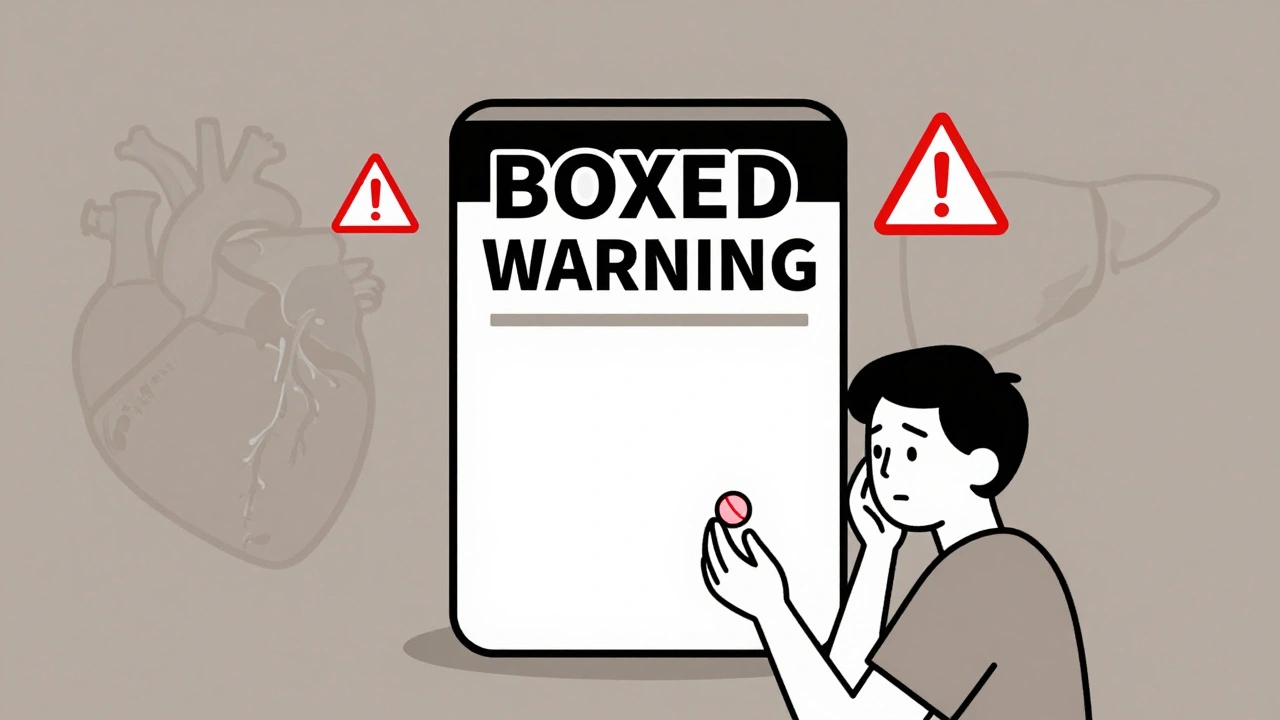
- Boxed Warning - This is the most serious alert. It’s a black border around bold text at the very top. If you see this, stop. Read it. Understand it. This section covers risks that can cause death or permanent injury. Warfarin has a boxed warning for major bleeding. Bupropion has one for suicidal thoughts in young adults. These aren’t guesses. They’re backed by clinical data.
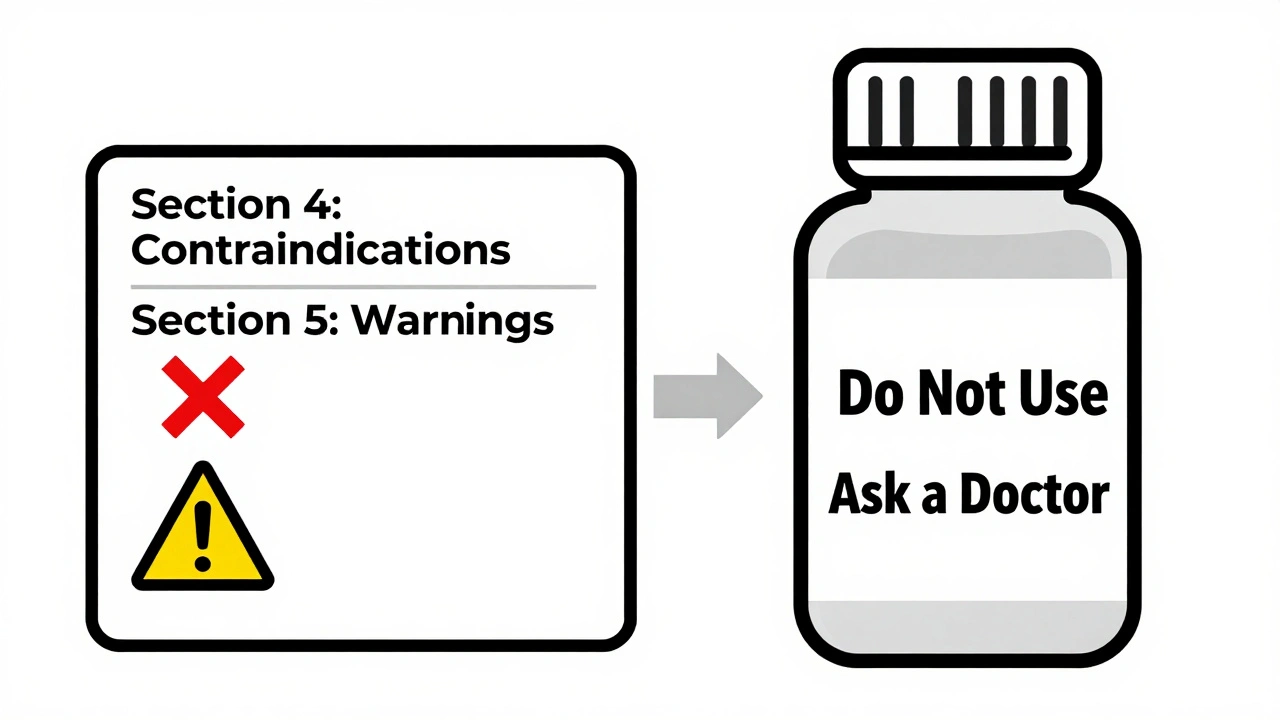
- Section 4: Contraindications - This section lists absolute reasons not to take the drug. It’s short. It’s blunt. It says: ‘Do not use if you have [condition].’ Common examples: allergies to ingredients, active bleeding, pregnancy (for some drugs), or severe kidney disease. If your condition matches one here, don’t take the drug unless your doctor explicitly says otherwise-and even then, they better have a solid reason.
- Section 5: Warnings and Precautions - This is the longest section. It’s where the real work happens. It lists serious side effects, interactions, monitoring needs, and conditions that require extra care. For example: ‘Monitor liver enzymes monthly,’ ‘Avoid alcohol,’ or ‘Use with caution in patients over 65.’ This section tells you what to watch for and when to call your doctor.
Don’t skip Section 5. It’s not filler. A 2021 study found that nearly 60% of doctors don’t fully read it-even for drugs they prescribe regularly. That’s why patients get hurt.
How OTC Labels Are Different (And Why You Still Need to Read Them)
Over-the-counter drugs don’t use the same format. They follow the FDA’s ‘Drug Facts’ label. Here’s how to decode it:
- ‘Do not use’ - This means contraindication. If it says ‘Do not use if you have high blood pressure,’ and you have high blood pressure, don’t take it. No exceptions.
- ‘Ask a doctor before use if’ - This is the OTC version of a warning. It’s telling you: ‘You might be at risk. Talk to someone.’ Common examples: ‘Ask a doctor if you have asthma,’ or ‘Ask a doctor if you’re pregnant.’ These aren’t suggestions. They’re red flags.
- ‘Stop use and ask a doctor if’ - This tells you when to stop taking the medicine and seek help. For example: ‘Stop use and ask a doctor if you develop a rash or dizziness.’ If you see this, act. Don’t wait.
A 2022 FDA study found that only 52% of people could correctly identify a contraindication on an OTC label. That means nearly half the people taking cold medicine, pain relievers, or allergy pills are ignoring the most important safety info on the package.
What ‘Relative’ vs. ‘Absolute’ Contraindications Really Mean
Not all contraindications are created equal. Some are absolute. Some are relative.
An absolute contraindication means: never use this drug. Example: ‘Contraindicated in patients with a history of anaphylaxis to penicillin.’ If you’ve had a life-threatening allergic reaction to penicillin, you should never take any penicillin-based drug. Period.
A relative contraindication means: use with caution. It’s not a flat ‘no.’ It’s a ‘maybe, but we need to watch you.’ Example: ‘Use with caution in patients with mild kidney disease.’ The drug can still be given, but the dose might need to be lowered, or you might need blood tests every few weeks.
The problem? Many patients-and even some pharmacists-don’t know the difference. One Reddit user shared how their cardiologist prescribed amiodarone despite mild lung disease. The label said ‘contraindicated in severe pulmonary disease.’ The pharmacist almost refused to fill it because they didn’t read the word ‘severe.’ That’s why you need to read the exact wording. Words matter.
Boxed Warnings: The Red Alert You Can’t Ignore
Boxed warnings are the FDA’s highest-level safety alert. They’re not optional. They’re not suggestions. They’re legal requirements based on evidence that the drug can cause death or serious injury.
Here’s what they look like: a thick black border around bold text at the top of the prescribing information. Examples:
- Warfarin: ‘Risk of major or fatal bleeding.’
- Isotretinoin (Accutane): ‘Risk of severe birth defects. Pregnancy must be avoided.’
- Fluoroquinolones (Cipro, Levaquin): ‘Risk of tendon rupture, nerve damage, and disabling side effects.’
These warnings weren’t added because someone had a bad day. They were added because hundreds of patients died or were permanently injured. A 2015 JAMA study found that 40% of new drugs approved between 2008 and 2012 got a boxed warning within five years. That’s not rare. It’s the norm.
If your drug has a boxed warning, ask your doctor: ‘What’s the risk for me? How will we monitor for it? Are there safer alternatives?’ Don’t accept ‘It’s fine.’ Push for clarity.
What to Do When You Find a Warning You Don’t Understand
Don’t guess. Don’t assume. Don’t ignore.
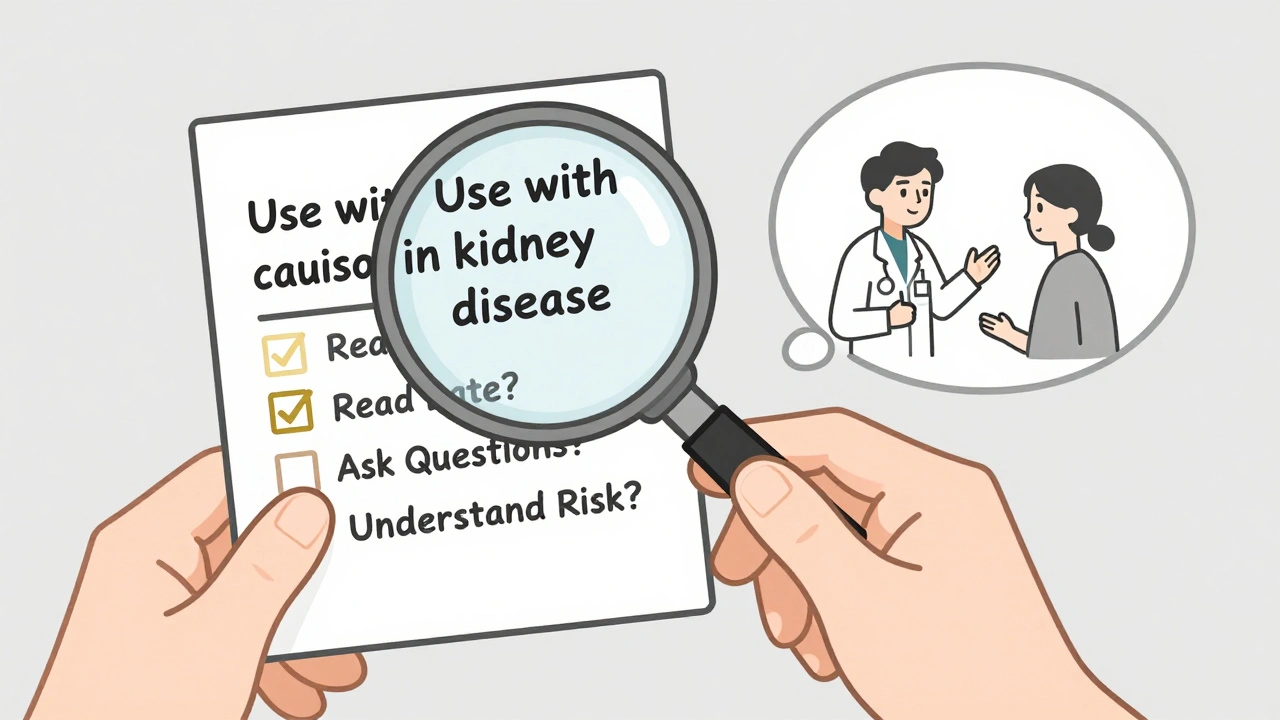
Write down the exact phrase from the label. Then ask your doctor or pharmacist these three questions:
- ‘What does this mean for me specifically?’ - The label talks about ‘patients with kidney disease.’ Do you have kidney disease? How bad is it? What does ‘mild’ or ‘moderate’ mean in your case?
- ‘How likely is this to happen to me?’ - Warnings often say ‘may cause’ or ‘risk of.’ But what’s the actual rate? For example, ‘Risk of liver injury: 1 in 1,000 patients.’ That’s very different from ‘risk of liver injury: 1 in 10.’
- ‘Is there something I can do to reduce the risk?’ - Maybe it’s avoiding alcohol. Maybe it’s getting blood tests every month. Maybe it’s switching to a different drug. Don’t leave this open-ended.
According to the Institute for Safe Medication Practices, patients who ask these questions are 70% less likely to experience a serious adverse event.
Why Drug Labels Keep Changing
Drug labels aren’t set in stone. The FDA updates them constantly based on new safety data. Between 2020 and 2023, over 147 drug labels were changed because of real-world safety reports. That’s not a glitch. It’s how the system is supposed to work.
For example, a drug might be approved with no warning for depression. But after 10,000 patients use it, and 300 report suicidal thoughts, the FDA forces the manufacturer to add a warning. That’s why the label you read last year might be different now.
Always check the date on your prescription label. If it’s more than a year old, ask your pharmacist: ‘Has this drug’s warning changed?’
How to Stay Safe
Here’s your quick checklist:
- Always read the label-don’t assume you know what’s there.
- Look for ‘Do not use’ on OTC drugs. That’s your contraindication.
- On prescriptions, find Section 4 (Contraindications) and Section 5 (Warnings). Read them both.
- If you see a boxed warning, don’t skip it. Ask your doctor about it.
- Write down any warning that confuses you. Ask your provider for clarification.
- Check the label date. If it’s old, ask if it’s been updated.
- Don’t rely on memory. Keep a printed copy of your drug’s warning section in your medication folder.
Medication safety isn’t about being scared. It’s about being informed. The label isn’t there to scare you. It’s there to protect you. But only if you read it.
What’s the difference between a contraindication and a warning on a drug label?
A contraindication means you should not take the drug at all because the risk of harm is too high-for example, if you have a severe allergy or a specific disease. A warning means the drug can be used, but with caution. It alerts you to serious side effects or conditions that require monitoring, like kidney disease or interactions with other medications. Contraindications are absolute; warnings are conditional.
Where are contraindications and warnings located on a prescription drug label?
On prescription drug labels, contraindications are in Section 4, titled ‘Contraindications.’ Warnings and precautions are in Section 5, titled ‘Warnings and Precautions.’ If there’s a boxed warning, it appears at the very top of the prescribing information, enclosed in a black border. These sections follow a strict FDA order to prioritize the most critical safety information.
What is a boxed warning, and why is it important?
A boxed warning, formerly called a black box warning, is the FDA’s strongest safety alert. It appears at the top of the prescribing information with a thick black border and bold text. It highlights risks that can cause death or serious injury-like major bleeding, liver failure, or suicidal behavior. These warnings are based on clinical evidence and must be taken seriously. If your drug has one, talk to your doctor about how the risk applies to you and what monitoring is needed.
How do I read warnings on over-the-counter (OTC) drugs?
On OTC drug labels, look for the ‘Warnings’ section under ‘Drug Facts.’ ‘Do not use’ statements indicate contraindications-absolute reasons to avoid the drug. ‘Ask a doctor before use if’ statements indicate precautions-conditions where you need medical advice before taking it. ‘Stop use and ask a doctor if’ tells you when to stop and seek help. Don’t skip this section-it’s often the longest and most important part of the label.
Why do drug labels change over time?
Drug labels are updated as new safety data becomes available. The FDA’s Sentinel Initiative and post-market surveillance track real-world use. If a drug causes unexpected harm in thousands of patients, the manufacturer must update the label. Between 2020 and 2023, over 147 drug labels were changed due to new safety reports. Always check the date on your label and ask your pharmacist if it’s been updated recently.
sagar bhute
December 2, 2025 AT 17:08The label says 'contraindicated in severe hepatic impairment' but my cousin took it anyway and lived. So much for FDA fearmongering. People die from being too scared to take medicine, not from the medicine itself.
Cindy Lopez
December 3, 2025 AT 16:06Contraindication ≠ warning. This is basic pharmacology. If you can't distinguish between 'do not use' and 'use with caution,' you shouldn't be self-managing medications. The FDA doesn't write these for fun.
James Kerr
December 4, 2025 AT 06:43Love this breakdown. Seriously, most people treat meds like cereal boxes-glance, pour, eat. But this? This is life-or-death reading. I keep a printed copy of my blood thinner's warning section taped to my fridge. No joke. Better safe than sorry.
vinoth kumar
December 5, 2025 AT 10:46I work in a pharmacy and see this every day. Someone comes in with a new script, reads the label for 3 seconds, and says 'it's fine.' Then they get upset when they get sick. Labels aren't there to scare you-they're there so you don't end up in the ER because you ignored 'do not use with alcohol.' Simple.
bobby chandra
December 7, 2025 AT 06:36Let me tell you-drug labels are the last fortress between you and a medical nightmare. Boxed warnings? Those aren't suggestions. They're red flares shot into the sky by scientists who watched people die because someone skipped the fine print. If your doctor says 'it's fine' and there's a black box warning? Push back. Hard. Your life isn't a gamble.
Archie singh
December 9, 2025 AT 01:35Most people can't read a label because they can't read at all. The FDA should just put a QR code that says 'call your doctor or die' and be done with it. This post is just preaching to the choir of people who already know how to read.
Kidar Saleh
December 10, 2025 AT 02:14Back in Dublin, my gran used to say: 'If the paper tells you not to, then don't.' She never went to college, never read a medical journal-but she knew more about safety than half the doctors I've met. Sometimes wisdom isn't in the textbooks, it's in the habits.
Chloe Madison
December 11, 2025 AT 03:58Just got prescribed metformin. Read the label. Saw 'use with caution in renal impairment.' Checked my last bloodwork-eGFR 62. Called my doctor. He said, 'Good catch. We'll monitor it monthly.' This isn't paranoia. This is responsibility. And it saved me from a hospital trip.
Vincent Soldja
December 12, 2025 AT 19:09OTC labels are poorly designed. The 'do not use' section is buried under 12 bullet points about storage and expiration. People miss it. This needs regulatory reform.
Makenzie Keely
December 12, 2025 AT 19:33PLEASE-always check the date on your label! I had a friend who took a generic version of a drug that had a brand-new boxed warning added six months before-she didn't know because her bottle was from last year. She ended up in the ICU. The pharmacist didn't even check. This isn't just about reading-it's about staying current.
Francine Phillips
December 13, 2025 AT 03:56My dad died from a drug interaction because he didn't tell his doctor he was taking ibuprofen daily. The label said 'ask your doctor if you have high blood pressure.' He had it. He didn't ask. It's not complicated. But people avoid it.
Albert Essel
December 14, 2025 AT 14:34One thing I've learned: the difference between 'relative' and 'absolute' contraindications matters more than most realize. I had a doctor tell me 'it's fine' about a drug with a relative contraindication-I pushed back, got a second opinion, and switched meds. Saved my kidneys. Never assume your doctor knows your full history. You're your own best advocate.
Charles Moore
December 16, 2025 AT 14:33This is the kind of post that should be required reading in high school. Not just for meds-but for everything. If you can't read a warning label, how are you supposed to read a contract, a loan, or a job offer? Literacy isn't just about words. It's about survival.